
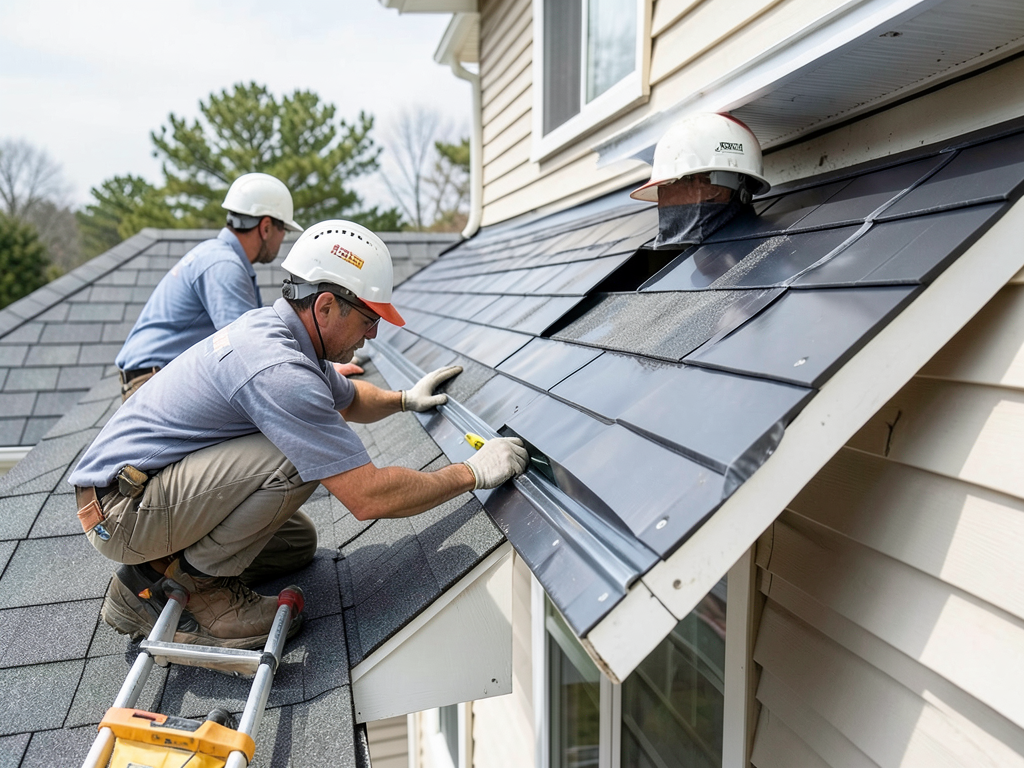
Why Your Ross Township Attic Needs Better Ventilation to Protect Your Shingles
Ross Township homeowners face unique challenges from Western Pennsylvania’s freeze-thaw cycles, heavy lake-effect snow, and humid summers. Poor attic ventilation creates conditions that accelerate shingle deterioration, void manufacturer warranties, and drive up cooling costs. This guide explains how proper airflow protects your roof investment and complies with Pennsylvania building codes. Homeowner’s Guide to Roofing.
Without adequate ventilation, Ross Township attics trap heat and moisture. In summer, temperatures can exceed 150°F, baking shingles from below and causing premature curling and granule loss. During winter, warm attic air melts snow on the roof, creating ice dams that force water under shingles. The result: costly repairs, mold growth, and shortened roof life.. Read more about Why Your Hampton Home Needs More Than Just Shingles to Stay Dry (The Role of Soffit and Fascia).
How Pittsburgh’s Climate Damages Poorly Ventilated Roofs
Allegheny County’s humid continental climate creates perfect conditions for attic moisture problems. Ross Township homes, many built between 1960-1990, often have inadequate ventilation systems that were designed before modern energy codes. When warm, moist air from living spaces rises into the attic, it meets cold roof surfaces and condenses into water droplets.
This moisture accumulation leads to several destructive processes. First, it saturates insulation, reducing R-value and creating thermal bridges. Second, it causes wood rot in roof decking and rafters. Third, it promotes mold and mildew growth that can spread to living areas. During freeze-thaw cycles, this trapped moisture expands and contracts, literally breaking apart roof components from the inside out.. Read more about What to Do When Raccoons or Squirrels Break Into Your Shaler Attic Through the Roof.
The problem intensifies with Ross Township’s specific architectural patterns. Many homes feature complex rooflines with multiple valleys and dormers that create ventilation dead zones. Cape Cod and colonial-style homes common in the area often have small, cramped attic spaces that trap heat and moisture more effectively than modern designs.. Read more about Signs Your Bridgeville Roof is Reaching the End of Its Life (And What to Check First).
The Science Behind Proper Attic Ventilation
Effective attic ventilation relies on the principle of convection: hot air rises and exits through upper vents while cooler air enters through lower vents. This creates continuous airflow that removes heat and moisture. The Pennsylvania Uniform Construction Code requires a minimum ventilation ratio of 1:300 for most attics, meaning 1 square foot of net free ventilation area per 300 square feet of attic floor space.
This balance requires both intake and exhaust components working in harmony. Intake vents, typically installed in soffits or eaves, provide the cool air entry point. Exhaust vents, located near the ridge or peak, allow hot air to escape. When properly sized and positioned, this system creates a natural chimney effect that keeps attic temperatures within 10-15 degrees of outdoor ambient temperature.. Read more about Fixing Leaky Chimney Flashing on Older Point Breeze Historic Homes.
The effectiveness depends on several factors specific to Ross Township homes. Roof pitch affects airflow dynamics – steeper pitches create stronger convection currents. Attic insulation levels impact heat transfer to the roof deck. And the presence of baffles between rafters ensures that intake vents don’t get blocked by insulation, maintaining proper airflow channels.
Common Ventilation Problems in Ross Township Homes
Many Ross Township homes suffer from ventilation deficiencies that compromise roof performance. The most common issue is blocked soffit vents, where insulation falls into the eave space and prevents air intake. This creates a one-way system where hot air can’t escape because cool air can’t enter.
Another frequent problem involves improperly installed or sized exhaust vents. Ridge vents that are too short for the roof length, or static vents placed too close together, create inadequate exhaust capacity. Some homes rely solely on gable vents, which only work effectively when wind blows directly through them – a condition that occurs less than 30% of the time in our region.
Attic bypasses represent a hidden threat unique to older Ross Township construction. Gaps around light fixtures, plumbing vents, and chimney chases allow conditioned air to escape into the attic. This not only wastes energy but also introduces moisture that ventilation systems struggle to remove. A typical 1970s home may have dozens of these small openings, collectively equivalent to leaving a window open year-round.
Ice Dam Formation and Prevention in Western PA
Ice dams form when heat escaping from the attic melts snow on the roof surface. The melted water flows down to the colder eaves where it refreezes, creating a barrier that traps additional meltwater. This process repeats throughout winter storms common to Ross Township, building up thick ice ridges that can lift shingles and allow water infiltration.
Proper ventilation is the primary defense against ice dams. By maintaining uniform roof temperatures, ventilation prevents the freeze-thaw cycle that creates ice dams. Combined with adequate insulation to minimize heat transfer from living spaces, this approach addresses the root cause rather than just treating symptoms.
The International Residential Code (IRC) Section R806 specifically addresses ice dam prevention in cold climates. It requires ice and water shield membrane extending at least 24 inches inside the exterior wall line on roofs with slopes less than 4:12. However, even with proper underlayment, ventilation remains critical for long-term ice dam prevention.. Read more about Choosing the Right Roof Underlayment for the Wet and Humid Pittsburgh Climate.
Ross Township’s specific conditions make ice dam prevention particularly important. The area’s elevation changes and proximity to the Great Lakes create microclimates where snowfall can vary dramatically within just a few miles. Homes in higher elevations or areas exposed to northwest winds often experience more severe ice damming than sheltered locations.
Types of Ventilation Systems for Ross Township Homes
Several ventilation approaches work effectively for Ross Township’s climate and housing stock. The most common and effective is the ridge-and-soffit system, which provides continuous ventilation along the roof’s entire length. This passive system requires no electricity and operates reliably in all weather conditions.
Ridge vents install along the peak of the roof, creating an uninterrupted exhaust path. Modern ridge vents feature external baffles that prevent rain and snow infiltration while allowing maximum airflow. They work best when paired with continuous soffit vents that provide uniform intake along the eaves.
For homes where ridge vents aren’t practical due to complex rooflines or aesthetic concerns, individual roof vents offer an alternative. These static vents, also called box vents or turtle vents, install near the ridge in multiple locations. While not as efficient as continuous ridge vents, they provide adequate ventilation when properly sized and spaced according to manufacturer specifications.
Power ventilation systems use electric or solar-powered fans to actively exhaust hot air. These work well for attics with unusual configurations or where passive systems prove insufficient. However, they require careful installation to avoid creating negative pressure that can draw conditioned air from living spaces.
Intake Ventilation Options for Ross Township Homes
Intake ventilation is often overlooked but proves equally important as exhaust. Soffit vents represent the most common intake method, installing in the underside of roof overhangs. Continuous soffit vents provide the most effective intake, but individual vents spaced every 4-6 feet also work well when properly installed.
Drip edge vents offer an alternative for homes without adequate soffit space. These install at the roof edge, providing intake ventilation in areas where traditional soffit vents aren’t feasible. They prove particularly useful for homes with narrow eaves or complex roof configurations common in Ross Township’s older neighborhoods.
Gable vents can supplement other intake methods but shouldn’t serve as the primary intake source. When wind conditions are favorable, they provide additional airflow. However, their effectiveness varies with wind direction, making them unreliable as a sole ventilation strategy. Reliable Commercial Flat Roof Repair in the Strip District and Downtown.
Foundation vents, while not technically attic ventilation, play a role in overall home ventilation strategy. Homes with crawl spaces benefit from properly functioning foundation vents that prevent moisture accumulation under the home, indirectly supporting attic ventilation by reducing overall humidity loads.
Calculating Your Ventilation Needs
Proper ventilation requires matching exhaust capacity to attic volume and local climate conditions. The basic calculation starts with attic floor area. For a typical Ross Township home with 1,500 square feet of attic space, the minimum required ventilation area equals 5 square feet (1,500 ÷ 300 = 5).
This total should split evenly between intake and exhaust – 2.5 square feet each. However, local conditions often require exceeding minimum standards. Ross Township’s high humidity and severe winters justify increasing ventilation by 50-100% to handle the additional moisture load.
Net free area (NFA) ratings help determine actual vent quantities. A standard 10-foot ridge vent might provide 4-5 square feet of NFA, while individual roof vents typically offer 0.5-1 square foot each. Soffit vents vary widely based on design, with continuous vents providing 1-2 square feet per linear foot.
Climate zone adjustments matter significantly. Pennsylvania falls in Zone 5 of the International Energy Conservation Code, where higher insulation levels and enhanced ventilation work together to manage moisture. Homes in Ross Township’s higher elevations may need additional ventilation compared to those in valley locations.
Impact on Energy Efficiency and Utility Costs
Proper attic ventilation directly affects Ross Township homeowners’ utility bills. During summer, a well-ventilated attic can be 20-30 degrees cooler than a poorly ventilated one. This temperature difference translates to reduced cooling loads – potentially saving $15-30 monthly on air conditioning costs for an average home. Expert Slate Roof Repair Services for Sewickley Historic Properties.
The savings compound over time. A roof with properly balanced ventilation might last 5-8 years longer than one suffering from heat and moisture damage. At current replacement costs averaging $8,000-12,000 for Ross Township homes, this extended lifespan represents $4,000-6,000 in avoided replacement expenses. How Much a Full Roof Replacement Actually Costs in Pittsburgh Right Now.
Winter energy efficiency also improves with proper ventilation. When attics maintain uniform temperatures close to outdoor ambient, heat transfer through the roof deck minimizes. This reduces the burden on heating systems and prevents the formation of ice dams that can cause costly water damage.
Energy Star certification standards, which many Ross Township homeowners pursue for utility rebates, require specific ventilation performance metrics. Homes meeting these standards typically achieve 15-20% better energy performance than code-minimum construction, with ventilation playing a crucial role in achieving these results.
Shingle Warranty Requirements and Ventilation
Major shingle manufacturers including GAF, CertainTeed, and Owens Corning explicitly require proper attic ventilation for warranty coverage. These requirements often exceed basic building code minimums, reflecting the critical role ventilation plays in shingle longevity.
Warranty voidance typically occurs when attic temperatures exceed specific thresholds or when moisture damage appears in the roof assembly. Documentation of proper ventilation installation may be required when filing warranty claims, particularly for premium shingle lines that carry 30-50 year warranties.
The International Building Code (IBC) Section 1203.2 requires attic ventilation in all climate zones, with specific requirements varying by region. Pennsylvania’s adoption of the 2018 IBC means Ross Township homes must meet these ventilation standards, regardless of when original construction occurred. 2018 International Residential Code ventilation requirements.
Insurance companies increasingly recognize the connection between ventilation and roof performance. Some providers offer premium discounts for homes with documented proper ventilation, while others may deny claims related to moisture damage in poorly ventilated attics.
Professional Assessment and Installation Process
Evaluating existing ventilation requires a systematic approach. Professional roofers start with visual inspection of intake and exhaust components, checking for blockages, damage, or inadequate sizing. They measure attic temperature and humidity levels, often finding conditions that exceed recommended maximums of 110°F and 70% relative humidity.
Thermal imaging helps identify heat loss patterns and moisture accumulation that aren’t visible to the naked eye. This diagnostic tool reveals bypasses where conditioned air escapes into the attic, creating localized hot spots that compromise overall ventilation effectiveness.
The installation process varies based on existing conditions. Simple upgrades might involve adding baffles to prevent insulation blockage or installing additional vents to meet code requirements. More complex projects could require removing sections of roofing to install ridge vents or modifying soffit configurations to improve intake airflow. Why Metal Roofing is Becoming the Top Choice for Homes in North Hills.
Permit requirements in Ross Township typically mandate ventilation upgrades when roofing replacements exceed 30% of the total roof area. This ensures that ventilation improvements accompany roof renewals, maintaining system integrity and code compliance.
Maintenance and Seasonal Considerations
Attic ventilation requires ongoing attention to maintain effectiveness. Seasonal maintenance should include checking for debris accumulation in vents, particularly after Ross Township’s frequent autumn leaf falls and spring storms. Even small amounts of blockage can reduce ventilation efficiency by 20-30%.
Winter maintenance focuses on ice dam prevention. While proper ventilation addresses the root cause, supplemental snow removal from lower roof edges prevents excessive snow loads that can overwhelm even well-designed systems. This proves especially important for homes near McKnight Road or other areas prone to wind-driven snow accumulation.
Summer inspections should verify that powered ventilation systems function correctly and that passive components remain unobstructed. High humidity levels common to Western Pennsylvania can cause vent screens to rust or deteriorate, requiring replacement to maintain airflow capacity.
Annual professional inspections help identify developing problems before they cause damage. These assessments should include moisture meter readings in the attic, infrared temperature scanning, and evaluation of insulation conditions that might affect ventilation performance.
Cost Considerations for Ross Township Homeowners
Ventilation improvements represent a modest investment compared to potential damage costs. Basic upgrades like adding baffles and cleaning existing vents might cost $300-500. More comprehensive improvements involving new vent installation typically range from $1,500-3,000, depending on roof complexity and materials selected.
These costs prove economical when compared to premature roof replacement, which can cost $8,000-15,000 for Ross Township homes. The energy savings from improved ventilation often offset a significant portion of upgrade costs within 3-5 years through reduced heating and cooling expenses.
Financing options may be available through utility companies or government programs promoting energy efficiency. Some Pennsylvania programs offer rebates for ventilation improvements that contribute to overall home energy performance, potentially reducing net costs by 20-30%.
The return on investment calculation becomes more favorable when considering warranty protection and extended roof life. A $2,000 ventilation upgrade that adds 5 years to a $10,000 roof represents a 40% improvement in long-term value.
Local Building Codes and Compliance
Ross Township falls under the Pennsylvania Uniform Construction Code, which adopts the International Residential Code with state-specific amendments. The ventilation requirements specify minimum net free area ratios and mandate proper installation techniques to ensure system effectiveness.
Local enforcement through Ross Township’s building department requires permits for most ventilation modifications, particularly when they involve structural changes or penetration of the roof surface. This oversight ensures installations meet safety standards and perform as intended.
Energy Star certification, while voluntary, has become increasingly common in Ross Township new construction and major renovations. This certification requires ventilation systems that exceed basic code requirements, promoting better long-term performance and energy efficiency.
Insurance considerations also influence ventilation decisions. Some carriers require documentation of proper ventilation as a condition of coverage, particularly for homes with recent roof replacements or those in areas prone to ice dam formation.
Frequently Asked Questions
How do I know if my attic has proper ventilation?
Check for even temperatures between your attic and outdoor air, absence of moisture or mold, and intact insulation. Professional assessment using thermal imaging and moisture meters provides definitive evaluation of ventilation effectiveness.
Can I install ventilation improvements myself?
While basic maintenance like cleaning vents is DIY-friendly, proper ventilation installation requires roofing expertise to ensure weathertight penetrations and code compliance. Improper installation can cause leaks and void warranties.
How long does ventilation improvement installation take?
Most ventilation upgrades complete in one day. Complex projects involving multiple vent types or addressing existing moisture damage may require 2-3 days for proper installation and testing.
Take Action to Protect Your Roof Investment
Don’t wait for visible damage to address ventilation problems. The cost of preventive improvements pales compared to premature roof replacement or water damage repairs. Ross Township’s climate demands proper attic ventilation to protect your home’s most important defense against the elements.
Professional assessment reveals specific deficiencies in your home’s ventilation system and provides targeted solutions. Whether you need simple maintenance or comprehensive upgrades, addressing ventilation now prevents costly problems later.
Call (878) 209-5522 today to schedule your attic ventilation evaluation. Our Ross Township roofing experts will inspect your current system, identify improvement opportunities, and provide a detailed plan to optimize your attic’s performance. Protect your shingles, lower your energy bills, and extend your roof’s life with proper ventilation.
Pick up the phone and call (878) 209-5522 before the next storm hits. Your roof – and your wallet – will thank you. For more information, visit U.S. Department of Energy ventilation guide.
You may also find this helpful. Preparing Your McCandless Roof for Future Solar Panel Installation.
You may also find this helpful. Removing Ugly Black Streaks and Moss from Your Shady Gibsonia Property.
{
“@context”: “https://schema.org”,
“@type”: “BlogPosting”,
“headline”: “Why Your Ross Township Attic Needs Better Ventilation to Protect Your Shingles”,
“description”: “Discover how proper attic ventilation prevents shingle damage in Ross Township’s harsh climate. Learn about intake/exhaust balance, ice dam prevention, and local building codes.”,
“wordCount”: 2732,
“datePublished”: “2026-03-07T07:30:00.000Z”,
“dateModified”: “2026-03-07T07:30:00.000Z”,
“inLanguage”: “en-US”,
“mainEntityOfPage”: {
“@type”: “WebPage”,
“@id”: “https://victoryroofingpittsburgh.com”
},
“publisher”: {
“@type”: “LocalBusiness”,
“name”: “Victory Roofing Pittsburgh”,
“url”: “https://victoryroofingpittsburgh.com”
},
“author”: {
“@type”: “Organization”,
“name”: “Victory Roofing Pittsburgh”,
“url”: “https://victoryroofingpittsburgh.com”
},
“image”: {
“@type”: “ImageObject”,
“url”: “https://victoryroofingpittsburgh.com/wp-content/uploads/2026/03/why-your-ross-township-attic-needs-better-ventilat-1.png”
}
}
{
“@context”: “https://schema.org”,
“@type”: “RoofingContractor”,
“name”: “Victory Roofing Pittsburgh”,
“url”: “https://victoryroofingpittsburgh.com”,
“address”: {
“@type”: “PostalAddress”,
“addressLocality”: “Pittsburgh”
},
“areaServed”: {
“@type”: “City”,
“name”: “Pittsburgh”
}
}
{
“@context”: “https://schema.org”,
“@type”: “FAQPage”,
“mainEntity”: [
{
“@type”: “Question”,
“name”: “How do I know if my attic has proper ventilation?”,
“acceptedAnswer”: {
“@type”: “Answer”,
“text”: “Check for even temperatures between your attic and outdoor air, absence of moisture or mold, and intact insulation. Professional assessment using thermal imaging and moisture meters provides definitive evaluation of ventilation effectiveness.”
}
},
{
“@type”: “Question”,
“name”: “Can I install ventilation improvements myself?”,
“acceptedAnswer”: {
“@type”: “Answer”,
“text”: “While basic maintenance like cleaning vents is DIY-friendly, proper ventilation installation requires roofing expertise to ensure weathertight penetrations and code compliance. Improper installation can cause leaks and void warranties.”
}
},
{
“@type”: “Question”,
“name”: “How long does ventilation improvement installation take?”,
“acceptedAnswer”: {
“@type”: “Answer”,
“text”: “Most ventilation upgrades complete in one day. Complex projects involving multiple vent types or addressing existing moisture damage may require 2-3 days for proper installation and testing.”
}
}
]
}
{
“@context”: “https://schema.org”,
“@type”: “BreadcrumbList”,
“itemListElement”: [
{
“@type”: “ListItem”,
“position”: 1,
“name”: “Home”,
“item”: “https://victoryroofingpittsburgh.com”
},
{
“@type”: “ListItem”,
“position”: 2,
“name”: “Blog”,
“item”: “https://victoryroofingpittsburgh.com/blog”
},
{
“@type”: “ListItem”,
“position”: 3,
“name”: “Why Your Ross Township Attic Needs Better Ventilation to Protect Your Shingles”
}
]
}
{
“@context”: “https://schema.org”,
“@type”: “Service”,
“serviceType”: “Roofing”,
“provider”: {
“@type”: “LocalBusiness”,
“name”: “Victory Roofing Pittsburgh”,
“url”: “https://victoryroofingpittsburgh.com”
},
“areaServed”: {
“@type”: “City”,
“name”: “Pittsburgh”
},
“description”: “Discover how proper attic ventilation prevents shingle damage in Ross Township’s harsh climate. Learn about intake/exhaust balance, ice dam prevention, and local building codes.”
}